£0.00
(0 items)
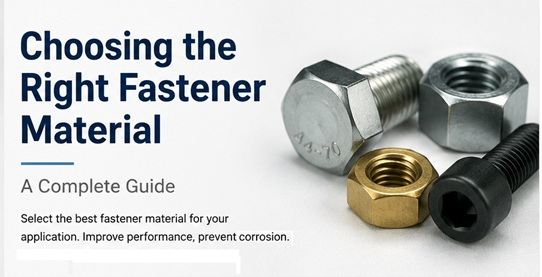
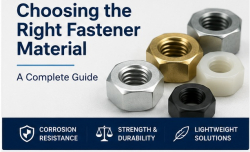
Whether you're working in construction, marine engineering, electrical installations, manufacturing, or general maintenance, understanding the strengths and limitations of different fastener materials will help you choose the most suitable fixing for your application.
Why Fastener Material Matters
Fasteners are exposed to a variety of environmental factors, including moisture, chemicals, temperature fluctuations, vibration, and mechanical loads. Choosing the wrong material can result in:
Selecting the correct material from the outset helps maximise the lifespan of both the fastener and the assembly. At Masons Fasteners, we supply a wide range of fasteners in various materials, each designed to perform in different conditions.
Steel Fasteners
Carbon steel remains the most commonly used fastener material due to its excellent strength and affordability.
|
Advantages |
Typical Applications |
|
High tensile strengths available |
General construction |
Considerations
Plain steel offers little corrosion resistance and is best used in dry indoor environments unless protected by a surface coating. Adding plating finishes provides a protective coating that delays corrosion, most commonly Zinc Plating provides steel fasteners with a protective coating that delays corrosion while maintaining an economical price.
See our Plating Finishes Guide for more information on Plating finishes and their uses.
Stainless Steel Fasteners
Stainless steel is one of the most popular choices where corrosion resistance is required.
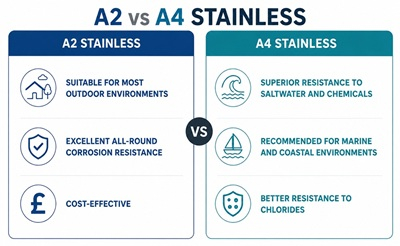
Common grades include A2 (304) and A4 (316).
|
Advantages |
Typical Applications |
|
Excellent corrosion resistance |
Marine |
A2 vs A4 Stainless Steel
Masons can quote for your Stainless-Steel Fasteners.
Contact us with your requirements.
Brass Fasteners
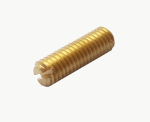
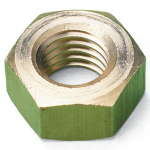
Brass fasteners combine excellent corrosion resistance with good electrical conductivity and an attractive decorative finish.
|
Advantages |
Typical Applications |
|
Corrosion resistant |
Electrical installations |
Brass is particularly popular where appearance and conductivity are important.
Aluminium Fasteners
Aluminium fasteners are significantly lighter than steel while still offering good corrosion resistance.
|
Advantages |
Typical Applications |
|
Lightweight |
Aerospace |
Aluminium fasteners are ideal where reducing overall weight is a priority.
Nylon Fasteners
Nylon fasteners offer excellent electrical insulation and are completely resistant to rust.
|
Advantages |
Typical Applications |
|
Lightweight |
Electronics |
They are particularly useful where electrical insulation is essential.
Preventing Galvanic Corrosion
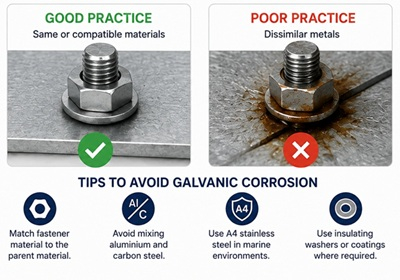
One of the most common installation mistakes is mixing incompatible metals.
When two dissimilar metals come into contact in the presence of moisture, galvanic corrosion can occur, causing one of the metals to corrode much more quickly.
Related Products
When selecting fasteners, it's important to use compatible components throughout your assembly. Browse our related product ranges:
Why Buy Fasteners from Masons Fasteners?
Masons Fasteners supplies high-quality industrial fasteners to customers throughout the UK. We stock a comprehensive range of standard and specialist fasteners in a range of materials, thread sizes and finishes.
Whether you're purchasing a handful of fixings or bulk quantities for manufacturing and engineering projects, our experienced team can help you find the right fastening solution for your application.
Browse our online range, or contact us with your enquiry, if we don’t stock it we can source it!
If you're unsure which fastener is right for your application, the team at Masons Fasteners is always happy to help.