£0.00
(0 items)
How to Identify an Unknown Screw Thread
A practical guide to measuring thread diameter, pitch and profile so you can identify a threaded fastener with confidence.
How to Identify an Unknown Thread
When you have a bolt, screw, nut or other fastener or fixing with no packaging or markings, identifying its thread can be difficult. A thread that looks almost right may still have a different diameter, pitch or profile — and forcing mismatched parts together can damage the threads or create an unreliable connection.
The good news is that most threads can be identified with a few simple checks. You will usually need a set of callipers, a thread pitch gauge and access to a reliable thread chart. This guide explains what to measure, which thread systems you may encounter, and how to check your result before selecting a replacement.
1. Check whether the thread is male or female
A male thread is on the outside of a component, such as a bolt or screw. A female thread is inside a component, such as a nut, tapped hole or threaded fitting.
External threads are generally easier to measure because you can access the thread crests directly. Internal threads can be more difficult: you may need to measure the opening carefully, use a thread gauge, or compare a known matching fastener. Do not assume the opening diameter is the nominal thread size.
2. Measure the thread diameter
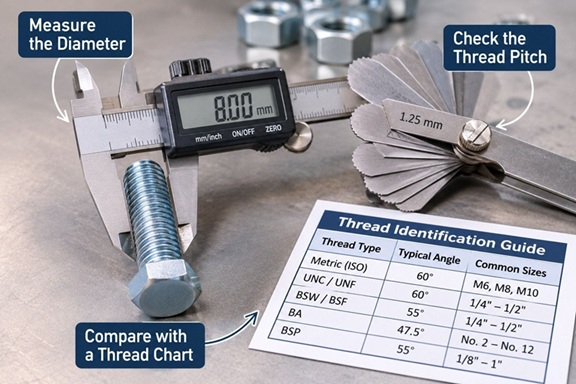
For an external thread, use callipers to measure across the widest part of the thread — from crest to crest. This is the major diameter. Take the measurement squarely across the thread and, if possible, check it at more than one point.
Compare the measurement with a recognised thread chart. Metric threads are normally identified by a nominal diameter in millimetres, while imperial threads use inch-based sizes. The measured diameter may be slightly below the nominal size because of manufacturing tolerances, wear, coatings or damage.
For example, a thread measuring close to 8 mm may be an M8 thread, but diameter alone is not enough to confirm it. You still need to identify the pitch and thread form.
3. Measure the thread pitch
Pitch is the distance between corresponding points on adjacent threads. It is one of the most important measurements because two threads can have similar diameters but different pitches.
Use a thread pitch gauge by placing its leaves against the thread. Try different leaves until the teeth sit neatly in the thread grooves with no visible gaps. Read the marking on the matching leaf.
On metric threads, pitch is the distance between threads in millimetres. On many imperial threads, the specification is given as threads per inch (TPI). Count the number of thread crests across one inch or use an imperial pitch gauge.
For example, M8 × 1.25 has an 8 mm nominal diameter and a 1.25 mm pitch. A 5/16-18 UNC thread has a nominal diameter of 5/16 inch and 18 threads per inch. These are not interchangeable, even though their diameters may appear similar.
4. Identify the thread standard
Once you have the diameter and pitch, compare them with a thread chart to narrow down the thread type. Common standards you may encounter include:
Do not identify a thread from diameter alone. Different standards can have close nominal diameters, and some thread pitches are similar enough to be confused by eye.
5. Check whether the thread is parallel or tapered
Pipe threads may be parallel or tapered. A parallel thread maintains the same diameter along its length, while a tapered thread gradually changes diameter.
This distinction matters because the thread form and sealing method are part of the connection design. Some parallel pipe connections seal using a washer, O-ring or other face seal; tapered threads are designed to tighten progressively and may require an appropriate thread sealant, depending on the application and specification.
If you are identifying a pipe fitting, also inspect the sealing arrangement and seat. Do not rely on the thread diameter alone to decide whether two fittings will connect or seal correctly.
6. Check the thread direction
Most fasteners use right-hand threads, which tighten when turn clockwise. Left-hand threads tighten anticlockwise and are used in applications where the direction of rotation or service conditions make them appropriate.
7. Compare your measurements with a reliable thread chart
Use your diameter, pitch and thread-family observations together. A thread chart can help confirm the likely nominal size, pitch and standard. Where the application is critical, verify the result against the relevant standard or the component manufacturer's technical information.
Masons Fasteners has a guide to common fastener thread types, along with additional reference material for BA threads and screw size conversions:
A Guide to Fastener Thread Types
Screw Size Conversion Chart
Still unsure?
If you need help identifying a thread or sourcing a suitable replacement, contact the team - they’ll be happy to help.
Check our guide to ‘Fastener Thread Types’